
You’ve gotten those LinkedIn messages from companies you’ve never heard of, asking for 15 minutes of your time or pitching a service you didn’t ask about. You probably ignored them, because everyone does.
Now think about the last time you got a message from someone whose posts you’d actually been reading for a few weeks. Someone whose name you recognized from your feed. Same message format, completely different reaction.
That gap between “delete” and “actually read it” is the core insight behind what we call The Dual Track Approach™, and it explains why most LinkedIn Ads campaigns underperform.
Why LinkedIn Ads Are Different
Every major ad platform has a primary mechanism. Google Ads responds to intent: someone searches, you show up. Facebook and Instagram interrupt a scroll: someone is browsing, your ad appears. LinkedIn does both of those things, and it adds something no other platform offers: a direct messaging channel.
You can show up in a prospect’s newsfeed with sponsored content. And you can land directly in their inbox with a message ad. On the same platform, targeting the same audience, running at the same time.
That combination changes the strategic playbook entirely. Most businesses treat these as two separate campaign types and pick one. The businesses getting the best results are running both simultaneously, on purpose, as a single coordinated strategy.
There’s a broader reason this matters for B2B specifically. Research from the LinkedIn B2B Institute and the Ehrenberg-Bass Institute found that only about 5% of potential B2B buyers are actively in-market at any given time. The other 95% aren’t ready to buy today, but they will be eventually. If you’re only running campaigns designed to capture the 5%, you’re ignoring almost everyone who will become a buyer in the future. The feed track is how you stay visible to that 95% so that when they do enter the market, your name is already familiar.
The Problem With Running One Track
When businesses try LinkedIn Ads, they typically lean in one direction.
Message ads only. You send a message to someone who has never heard of you. It reads like cold outreach wearing a LinkedIn costume. Response rates are low, and prospects who do respond are often lukewarm at best. The fundamental problem is that you’re asking someone to start a conversation with a stranger, and most people aren’t interested in doing that.
Feed ads only. You run sponsored content that gets some engagement, maybe some clicks to your website. But the path from “I saw their post” to “let’s actually talk” is long and passive. There’s no natural mechanism to start a real business conversation. You’re building visibility without a way to convert it into a relationship.
Both approaches produce some results. Neither produces what it should. And businesses that try one track, see mediocre numbers, and conclude that LinkedIn Ads don’t work for them are often making a decision based on half a strategy.
The Dual Track Approach
We developed The Dual Track Approach over the past couple of years running LinkedIn Ads campaigns, both for our own B2B outreach and for clients in industries like commercial printing, business brokerage, and manufacturing. The pattern held regardless of industry: the best results came when both tracks ran at the same time.
Here’s how it works.
Track 1: Message-first, supported by feed. You start conversations through message ads with a soft, conversational ask. Something along the lines of “We had a few ideas about how we might be able to help your team. Mind if we send over some info?” At the same time, you run feed ads so your name and content keep showing up in the prospect’s newsfeed. Even if they don’t reply to the first message right away, the feed exposure builds familiarity. When you follow up, you’re no longer a complete stranger.
Track 2: Feed-first, supported by message. You build visibility and credibility by showing up consistently in the newsfeed with sponsored content: thought leadership, industry insights, and client results. When the message ad eventually arrives, the prospect already recognizes your name. They’ve seen your thinking. The message converts at a higher rate because you’re already a familiar presence.
Once both tracks are running, every prospect gets reached from both directions. The message makes the feed ads more noticeable (“Oh, that’s the company that messaged me”). The feed ads make the next message more welcome (“Oh, I’ve been seeing their stuff”). It creates a reinforcing loop, and the longer both tracks run together, the stronger the effect becomes.
LinkedIn’s own data supports this. According to their published best practices, advertisers running Sponsored Messaging alongside Sponsored Content in one case study saw a 19% uplift in open rates and a 72% increase in click-through rates compared to running message ads alone. The two formats make each other work harder.
How the Reinforcing Loop Works
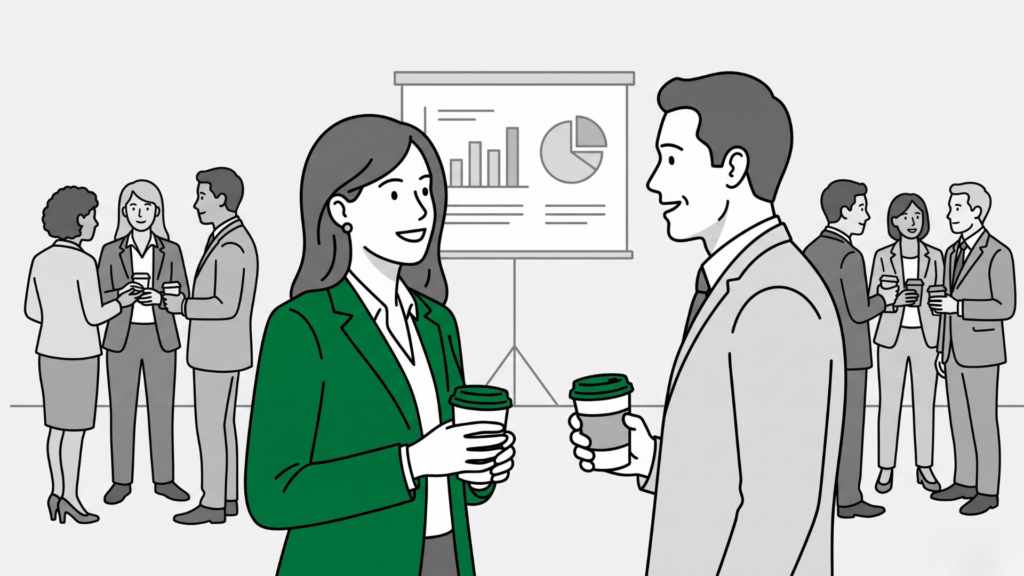
Think about networking at a conference. There’s a meaningful difference between walking up to someone cold in the lobby and introducing yourself, versus approaching that same person at the coffee break after they’ve already seen you on a panel, noticed your company’s booth, and heard your name come up in conversation. Same introduction, completely different starting point.
The feed track is everything that happens in the room before you walk over. The panels, the booth, the conversations where your name comes up. It’s the one-to-many visibility that makes you a familiar presence. The message track is the one-to-one moment: the direct approach at the coffee break, where you start a real conversation. At a good conference, those two things feed each other. The people you approach already know who you are because they’ve been seeing you all day. And your broader presence becomes more memorable because people connect it to a real conversation they had.
In practice, the timeline looks something like this. During the first several weeks, prospects start seeing your feed content. They may not click or engage, but they’re registering your name and your expertise. LinkedIn campaigns typically need four to six weeks for the algorithm to optimize through its learning phase, with the first two weeks often running below peak performance. Around weeks four through six, the message track gains traction. At that point, the prospect has seen your content multiple times and received a message or two. The follow-up doesn’t feel like another cold outreach attempt. It feels like the natural next step in something that’s already been building.
The reinforcing effect takes time to develop, and budget plays a real role in how quickly that happens. A business investing several thousand dollars a month will see the algorithm learn and the loop start compounding much faster than one spending a few hundred. Patience is genuinely part of the strategy. Businesses that run both tracks for a few weeks, don’t see immediate conversions, and shut things down are pulling the plug right before the compounding would have kicked in.
What Each Track Looks Like
A few principles to keep in mind as you think about building this out.
On the message side, tone matters as much as targeting. Message ads that read like sales pitches get ignored regardless of how precisely you’ve targeted them. The best-performing messages feel like a real person starting a genuine business conversation. Keep them short: LinkedIn’s own data shows that message ads with body text under 500 characters see a 46% higher click-through rate on average. Make it easy for the prospect to say yes to a low-commitment next step, and use Lead Gen Forms so they can respond directly within LinkedIn rather than being sent to an outside page.
Follow-up sequences are important too. Most conversions come from the second or third touch, not the first. One detail worth knowing: LinkedIn limits you to messaging the same person once every 45 days. That built-in spacing actually works in your favor, because it gives the feed track time to do its job between messages.
On the feed side, the content you promote should demonstrate that you understand your prospect’s world. Thought Leader ads and video work well for the visibility layer, building familiarity and credibility over time. For a mid-funnel offer, document ads (promoting a valuable resource like a guide or checklist) give prospects a reason to engage more deeply. The goal isn’t brand awareness in the abstract. You’re creating enough familiarity and credibility that when the message arrives, the prospect already has a reason to pay attention.
Budget allocation between the two tracks matters more than most businesses realize. As a general starting point, a 70/30 split favoring the feed track over message ads tends to work well. That weighting makes sense for a few reasons: the feed is doing the longer-term brand-building work that makes everything else convert better, and the 45-day messaging frequency cap means you can’t scale message volume the way you can scale feed impressions.
Neither track should be an afterthought. If you put 90% of your budget into messages and treat the feed as optional window dressing, you’re essentially running one track with a thin layer of the other on top, and you won’t see the reinforcing effect.
Is the Dual Track Approach Right for Your Business?
LinkedIn Ads aren’t the right fit for every business. The Dual Track Approach works best when a few conditions are true: your average deal size is large enough to justify LinkedIn’s higher cost per click (which tends to run significantly higher than Google or Facebook), your target audience is reachable by job title, industry, or company size, your sales cycle involves relationship-building, and you have genuine expertise worth sharing in the feed.
There’s also a practical budget floor to consider. To run both tracks with enough volume for the algorithm to learn and the reinforcing loop to develop, plan on a minimum of roughly $2,500 per month in total ad spend. Below that, you may not generate enough impressions and messages for the dual track effect to take hold.
If your business is B2B with higher-value transactions and a clearly definable audience, LinkedIn is often one of the strongest paid channels available. If you sell a lower-priced product directly to consumers, your ad budget is almost certainly better spent elsewhere.
This connects to a broader principle we use when helping clients allocate their marketing budget. The best traffic source for your business depends on your model, your margins, and your timeline. LinkedIn might be your primary paid channel, your secondary channel, or not in your mix at all. The Dual Track Approach is the playbook for businesses where LinkedIn is the right fit.
Need Help With LinkedIn Ads?
If you’re considering LinkedIn Ads for your business, or you’ve tried them and the results haven’t matched the investment, we can help you build a Dual Track strategy designed around your audience and goals.